
France's landmark vibrational sites are abbeys, megaliths or summits to which visitors, radiesthesists or pilgrims attribute a particular energy. Here are fifteen of these sites, with what can be seen there, what is said about them and a tip for the visit. To locate them, the map of energy sites brings together all our entries.
What "landmark vibrational site" means
The expression comes from esoteric circles and radiesthesia. It refers to a place where people say they feel something more intense than elsewhere. Some explain it by telluric currents or by "vibrations" they measure with a pendulum, but no scientific study has established the existence of these energies.
The history of these places, by contrast, can be verified. Most are sanctuaries where people have prayed for centuries, standing stones raised five or six millennia ago, or isolated summits with far-reaching views.
Abbeys and sanctuaries
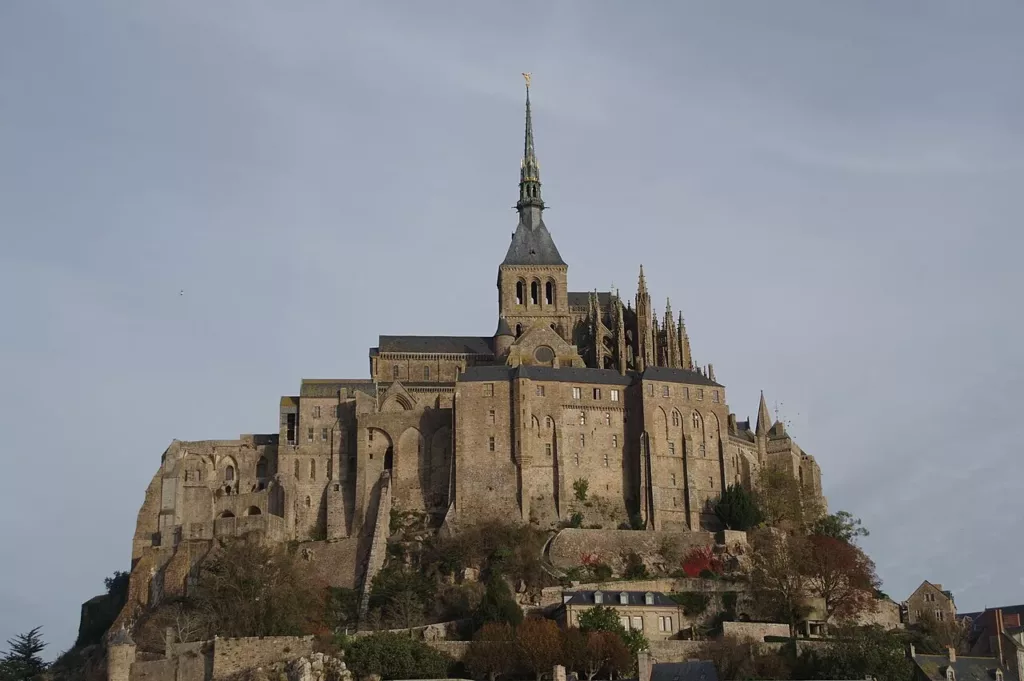
Mont-Saint-Michel (Manche)
The Abbey of Mont-Saint-Michel crowns the rock in the bay. According to a ninth-century account, the Archangel Michael appeared in a dream to Bishop Aubert, and the church was dedicated to him in 709; Benedictine monks settled there in 965 or 966. Visitors climb up for the Gothic Merveille and its cloister, three of whose arcades open onto the void. A community still prays there: come early and keep silent during the services.
Chartres Cathedral (Eure-et-Loir)
Rebuilt over some thirty years after the fire of 1194, Chartres Cathedral retains about 2,600 m² of stained glass spread across 172 bays. In the nave, a 12th-century labyrinth traces a route of more than 261 metres. A tradition formed in the 14th century links it to an ancient Druid cult: it is a myth, but it has done much for the site's reputation. Ask at reception when the labyrinth is open to walking, and follow it slowly.
The Basilica of Vézelay (Yonne)
On its Burgundian hill, the Basilica of Saint Mary Magdalene at Vézelay is a former 12th century abbey church and a stage on the Way to Santiago. In 1976, a Franciscan noticed that at noon on the summer solstice, light draws a line of bright patches down the middle of the nave. The Fraternities of Jerusalem celebrate the liturgy there three times a day, and attending a service lets you see the place alive.
The Abbey of Gellone (Hérault)
Deep in the Hérault gorges, the Abbey of Gellone was founded shortly before 804 by Guilhem, Count of Toulouse, who came there to end his days. The village of Saint-Guilhem-le-Désert grew up around it, on the Way of St James from Arles to Compostela, and the abbey has been a World Heritage Site since 1998. The Romanesque abbey church has remained the village church: one enters there speaking in a low voice.
Sénanque Abbey (Vaucluse)
Near Gordes, the Abbey of Sénanque has occupied a narrow valley since the arrival of the Cistercians in 1148. The Romanesque abbey church, roofed with lauzes, and the cloister with its round arches follow the austerity of the order. A small community of monks lives from lavender, honey and its bookshop. Their guesthouse welcomes people who wish to share a few days of their life of prayer in silence.
The Abbey of Saint-Michel de Cuxa (Pyrénées-Orientales)
At the foot of the Canigou, the Abbey of Saint-Michel de Cuxa still houses Benedictine monks. Its church, consecrated in 975, is among the great pre-Romanesque buildings. Its round crypt, whose vault rests on a single central pillar, no doubt partly explains its reputation among enthusiasts of energy sites. If you come in August, the Pablo Casals festival holds its concerts at the abbey.
Cluny Abbey (Saône-et-Loire)
Founded in 910, the Abbey of Cluny was the head of a vast network of Benedictine monasteries. Its church, 187 metres long, remained the largest in the West until the rebuilding of Saint Peter's in Rome, before being demolished between 1798 and 1813. About 8% of it survives, including the south arm of the great transept. Start from this transept, still standing, to imagine a vault rising to 33 metres, then continue on to the other energy sites of Bourgogne-Franche-Comté.
Notre-Dame-de-la-Mer church (Bouches-du-Rhône)
With its battlements and wall walk, the Notre-Dame-de-la-Mer church at Saintes-Maries-de-la-Mer looks like a fortress. According to tradition, Mary Jacobe and Mary Salome landed on this Camargue coast, and the crypt houses the statue of Sara the Black. The festivals of 25 May and 22 October are the high points of the pilgrimage. On other days, go down into the crypt quietly: people come there first of all to pray.
The Chapel of Saint-Michel d'Aiguilhe (Haute-Loire)
At Aiguilhe, next to Le Puy-en-Velay, the Chapel of Saint Michael of Aiguilhe must be earned: 268 steps lead to the top of a volcanic plug 82 metres high. The first oratory was completed in 961, and the Romanesque façade combines a trilobed arch, two sirens and a mosaic of coloured stones. As was customary in the Romanesque period, the archangel looks down over the cathedral. Climb without hurrying.
Megaliths
The Carnac alignments (Morbihan)
Nearly 3,000 standing stones erected around 4,500 years BCE stretch for about four kilometres: the Carnac alignments have been listed as a UNESCO World Heritage Site since July 2025. Legend has it that they are soldiers turned to stone by Saint Cornely. Out of season, the menhir fields are freely accessible; in summer, entry is only with a guided tour.
La Roche-aux-Fées (Ille-et-Vilaine)
At Essé, south-east of Rennes, the Roche-aux-Fées is a gallery grave of some forty slabs of purple schist, 19.5 metres long and dated to between 3000 and 2500 BCE. According to legend, fairies brought the stones, the heaviest of which weigh 40 to 45 tonnes. At dawn on the winter solstice, on a clear day, a patch of light moves across the back slab for a few minutes. The monument is fragile: stay behind the low fence, then continue with the other energy sites in Brittany.
Summits
The Pech de Bugarach (Aude)
The highest point of the Corbières, at 1,230 metres, the Pech de Bugarach is nicknamed the "inverted mountain" because its oldest rock layers lie above the more recent ones. New Age circles attribute "telluric" properties to it. In 2012, a rumour held that it would be spared the end of the world, and a municipal order banned access to the peak during December. A variant of the GR 36 passes the summit, from which the view stretches from the Pyrenees to the Mediterranean.
Mont Sainte-Odile (Bas-Rhin)
At 764 metres above the Alsace plain, Mont Sainte-Odile is home to the Hohenbourg abbey, attested in 738 and linked to the patron saint of Alsace. The plateau is encircled by the Pagan Wall, a rampart of about eleven kilometres whose purpose is unknown and whose date remains debated. Wear good shoes to walk along the wall, and look on the map for the other energy sites of the Grand Est.
Mont Aigoual (Gard)
The highest point in the Gard, at 1,565 metres, Mont Aigoual has housed a weather observatory built like a small fortress since 1894. The wind blows hard there more than 260 days a year, and fog covers it for about 240 days: the atmosphere at the summit is first and foremost shaped by this harsh climate. From Valleraugue, the climb of the "4,000 steps" leads up to the observatory. Along with Bugarach, Gellone and Cuxa, the Aigoual is one of the energy sites of Occitanie.
The Bavella Needles (Corse-du-Sud)
Above the Bavella pass, near Zonza, the Aiguilles de Bavella rise as seven granite towers, the highest point of which reaches 1,857 metres. Pines twisted by the wind and tafoni, the cavities that give the rock the look of a sponge, make it one of the Corsican landscapes that enthusiasts of energy sites cite first. The site belongs to the Corsica regional natural park and camping is prohibited there: come for the day.
Extend the visit with a retreat
These sites can be visited in a few hours, but you can extend your stay with a course or retreat in the same region. The course calendar gives the next dates, and the list of retreat venues helps you find somewhere to stay.
Frequently asked questions
Does one need to believe in energies to visit these places?
No. The history, architecture and landscape are reason enough for the journey. The energy attributed to these sites is a matter of belief or tradition.
Is there a map of energy sites in France?
Yes. The RetreatCenterGuide map locates each site and links to its listing, which gives its history and practical details.
Can one meditate or practise yoga on site?
A quiet, discreet moment of silent meditation disturbs no one. For a group session, first ask the site's permission: many are active churches or protected sites.
Illustrative photo: AlSepPhoenix, CC BY 4.0, via Wikimedia Commons.