

The term energy vortex is used in France to refer to a place where the energy of the earth is said to be stronger or to spiral. The word comes from the United States, and no measurement has ever established the existence of such vortices. Here is where it comes from, what those who use it put into it, and the French sites that have the reputation, all shown on the map of energy sites.
A term that came from Sedona
In physics, a vortex is a whirl: water draining from a sink or the air of a tornado rotates around an axis. The spiritual sense of the word was born in Sedona, Arizona, around the turn of the 1980s. The medium Page Bryant then designated several rocks and hills there as "vortices", points where the earth's energy was said to rise towards the sky or sink into the ground.
The word spread around the world with the New Age movement. Sedona became a destination for spiritual pilgrimage, and people began looking for vortices elsewhere, including in Europe.
What those who use the term put into it
For its followers, a vortex is a place where one feels an energy more intense than elsewhere. Some classify them as "electric" vortices, said to stimulate, and "magnetic" ones, said to invite introspection. Others link them to telluric currents, the Hartmann network or measurements taken with a pendulum in Bovis units.
Visitors' accounts speak of tingling, warmth, a sense of calm or, on the contrary, of agitation. These impressions are real for those who describe them. They vary greatly from one person to another, and the same person does not always feel the same thing in the same place.
Why science does not recognise it
Despite its vocabulary borrowed from physics, the energy vortex has no measurable definition. No instrument detects an energy specific to these places, and the terms "electric" or "magnetic" do not carry their physical meaning here. The Hartmann grid and telluric currents in the esoteric sense have not been demonstrated either.
The sensations, for their part, can be explained without invoking an unknown energy. Altitude, wind, the tiredness of the climb, the silence of a sanctuary or what one expects of the place are enough to change what one perceives. Nothing prevents one from being sensitive to it, but no study has established that a place acts on the body through a particular energy.
The French sites that have the reputation
Bugarach Peak
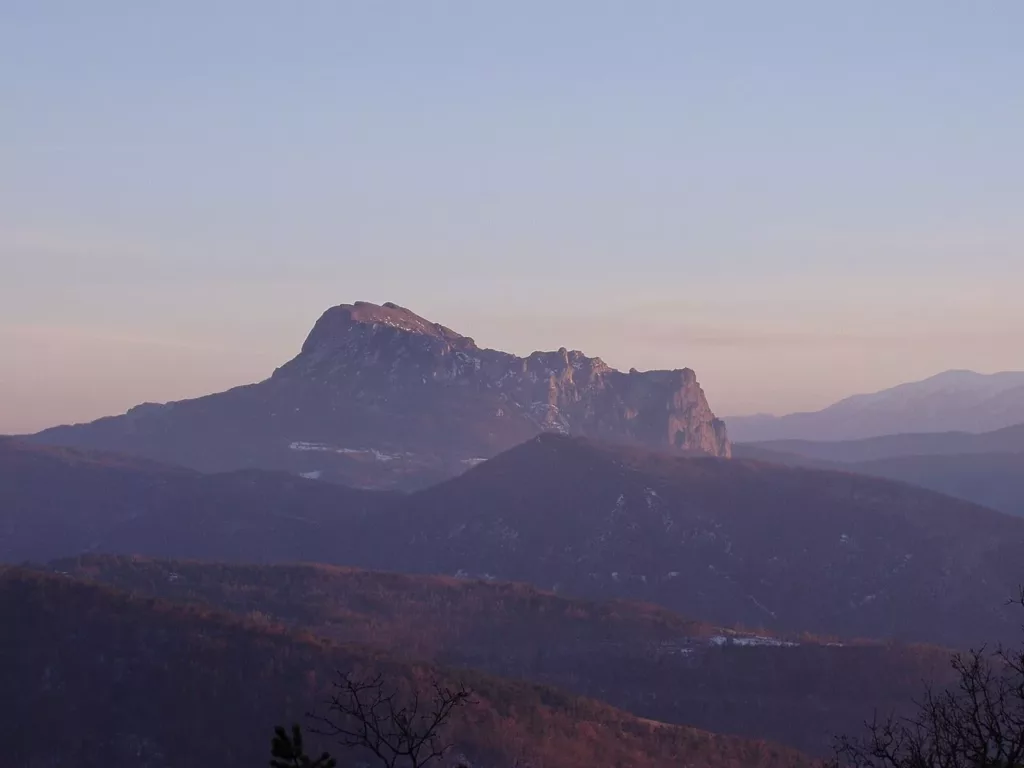
In the Aude, the Pech de Bugarach rises to 1,230 metres above the Corbières. It is nicknamed the 'inverted mountain': a thrust sheet has turned the layers over, so the rocks at the top are older than those at the bottom. New Age circles attribute 'telluric' properties to it and have made it the French example of the vortex. The mountain has been a listed site since 2017, and a variant of GR 36 leads to the summit.
From 2010, an interpretation of the Mayan calendar circulating online presented Bugarach as the only place spared by an end of the world predicted for December 2012. The village saw an influx of visitors, then of journalists. A municipal order banned access to the peak during that December, and the authorities supervised the gathering with high-mountain gendarmes. The episode later inspired several episodes of Plus belle la vie, then a series, Bugarach, broadcast in 2024.
Mont Aigoual and the Aiguilles de Bavella
The highest point in the Gard at 1,565 metres, Mont Aigoual is often cited among the 'special' summits. The wind blows strongly there more than 260 days a year, and on very clear days the view reaches the Alps and the Pyrenees. Its forests, however, are recent: the mountain was reforested from 1875 under the direction of the forester Georges Fabre. The Aigoual, like Bugarach, is counted among the energy sites of Occitanie.
In Corsica, the Aiguilles de Bavella rise in seven towers of granite above the Bavella pass, near Zonza, up to 1,857 metres. Their jagged outline and the wind-twisted pines earn them a place on vortex lists. The GR 20 runs at their foot, and camping is forbidden within the site.
Mont-Saint-Michel, Chartres and Aiguilhe
Three sanctuaries come up often in these lists. The Abbey of Mont-Saint-Michel, dedicated to the archangel Michael since the 8th century, still houses a monastic community. For Chartres Cathedral, rebuilt after the fire of 1194, attention turns to the labyrinth in the nave and to the crypt.
At Aiguilhe, near Le Puy-en-Velay, the chapel of Saint-Michel d'Aiguilhe stands on the summit of a volcanic plug 82 metres high, 268 steps above the ground. Its first oratory dates from 961. In the Romanesque period, the archangel was often placed above sanctuaries of the Virgin, and the chapel here overlooks the cathedral of Le Puy.
These three buildings are first of all places of worship. Their reputation as vortices is recent compared with their history, which is made of centuries of prayer and pilgrimage.
The Carnac alignments
In Morbihan, the Carnac alignments comprise nearly 3,000 menhirs erected around 4,500 years before our era. Since the 19th century they have been credited with a range of functions, from sun worship to an agricultural calendar, and some today see in them a network of telluric currents. The site has been a UNESCO World Heritage Site since July 2025. Out of season, access is free; in summer, the menhir fields are entered on guided tours.
Visiting these places with respect
In churches and abbeys, the visit stops where prayer begins: lower your voice during services and check the visiting conditions. On the summits, check the weather and allow time for the descent. At Carnac, as elsewhere, stay on the paths and do not climb on the stones.
Extend the visit with a retreat
These places can be the starting point of a longer stay. The retreat agenda lists retreats and workshops across France, and the list of retreat venues helps you find where to stay near the site that draws you.
Frequently asked questions
What is an energy vortex?
In New Age language, it is a place where the energy of the earth is said to be concentrated. The term comes from Sedona, Arizona, and corresponds to no physical quantity.
Where to find a vortex in France?
The sites most often cited are isolated summits such as the Bugarach, ancient sanctuaries and megaliths. It is a reputation, not an established ranking.
What happened at Bugarach in 2012?
A rumour made it a refuge from an end of the world announced for December 2012. The commune banned access to the summit during that month, and the authorities managed the influx of visitors.
Illustrative photo: ThierryS, CC BY-SA 3.0, via Wikimedia Commons.