
The Bovis scale is a graduated scale that dowsers use, with a pendulum, to assign a "vibratory" value to a food, a person or a place. Here is where it comes from, how it is used, and why this measure has received no scientific validation. The sites mentioned below each have their own entry, gathered on the map of energy sites.
Alfred Bovis and André Simoneton
The scale is named after Alfred Bovis, a French radiesthesist active in the 1930s. He is remembered mainly for the idea that everything emits a more or less "vital" radiation, which the pendulum could supposedly quantify. His biography is poorly documented, and the texts that cite him say little about his life.
The scale owes its spread to André Simoneton, who took it up after the war to classify foods by their "radiovitality". His book Radiations des aliments, ondes humaines et santé made the Bovis units known well beyond the circle of dowsers. The natural food movement, then the wellness and sacred sites communities, subsequently adopted them.
What the biometer is
The Bovis biometer is a graduated rule along which the pendulum is moved. The markings run from zero to several tens of thousands of units. These units have no physical definition: they serve as reference points for the operator.
Radiesthesists broadly agree on a few thresholds. Around 6,500 units, the value is said to be "neutral", compatible with human life; below that, the site or foodstuff is judged exhausting; above 10,000, one speaks of an "etheric" or spiritual level. Some compare the Bovis unit with the ångström, a unit of wavelength, but this comparison has never been explained or measured.
These thresholds are conventions within radiesthesia. They vary from one author to another, which explains why two books sometimes give very different figures for the same place.
How dowsers use it
The most common method is to hold the pendulum over the biometer while thinking of the place or object to be assessed. The operator moves the pendulum along the scale, or waits for it to change movement, and notes the graduation at which that change occurs.
Another method is practised without any fixed rule. A second person calls out figures, rising or falling, and the radiesthesist stops them when the pendulum "responds". On site, some walk through the building and note the points where the value seems stronger to them. Others work at a distance, from a photograph or a plan of the place.
In every case, it is the operator who decides when the pendulum has changed its movement. Radiesthesists themselves stress the concentration and neutrality that reading requires, which in effect acknowledges the role of the person in the result.
The figures put forward for a few sites
In radiesthesia books, certain sites are given values well above the threshold of 10,000 units. These figures are claims made by radiesthesists, not readings. What can be verified at each site is found elsewhere.
Chartres
Chartres Cathedral is one of the sites most often cited in these readings. Radiesthesists readily point to the labyrinth in the nave, a 12th-century design more than 261 metres long, or the crypt and its Well of the Holy Forts. What is known with certainty concerns the building itself: a cathedral rebuilt after the fire of 1194, with roughly 2,600 m² of stained glass.
Mont-Saint-Michel
The Abbey of Mont-Saint-Michel also features at the top of the lists. Its history alone is enough to explain the site's appeal: a sanctuary dedicated to the Archangel Michael since the 8th century, Benedictine monks installed there in the 965 or 966, and a community that still prays there. Figures in Bovis units add nothing verifiable to that account.
Vézelay
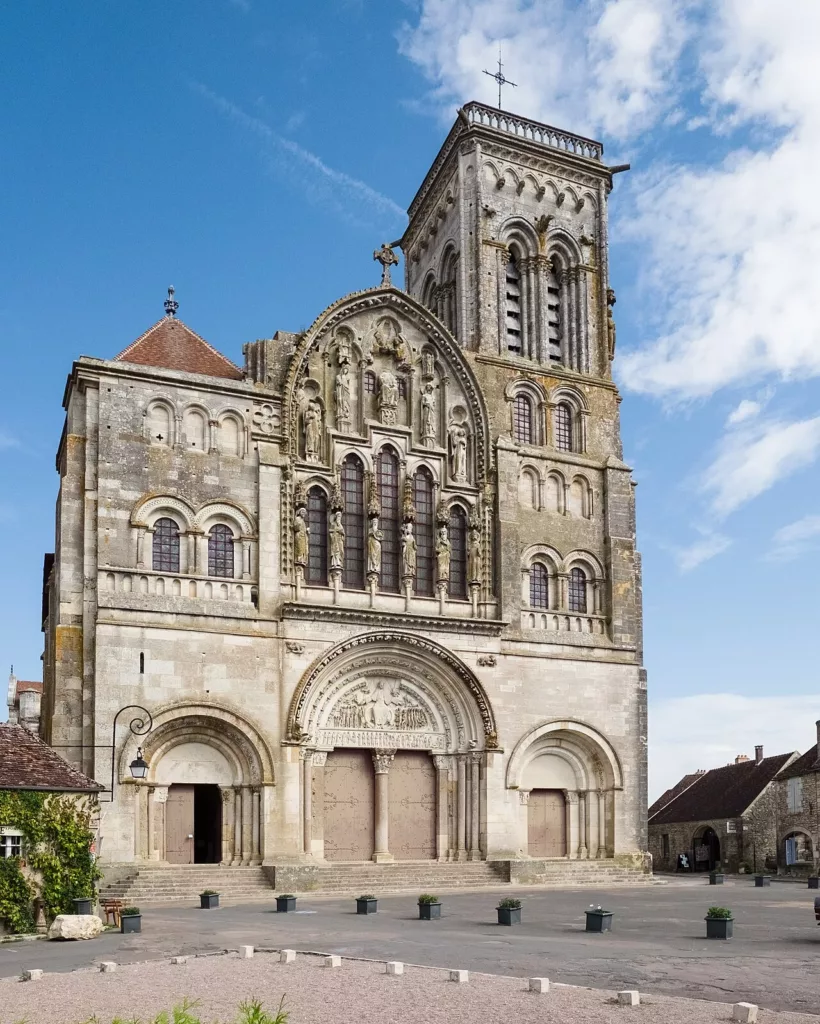
For the Basilica of Saint Mary Magdalene at Vézelay, dowsers also put forward high values. One fact, however, has been observed: in 1976, a Franciscan friar noticed that at midday on the summer solstice, light from the south windows casts a line of bright patches down the middle of the nave. This phenomenon can be seen with the naked eye, without a pendulum.
Carnac
The Carnac alignments receive the same treatment. Nearly 3,000 menhirs were erected there around 4,500 years before our era, and the site has been listed as a UNESCO World Heritage Site since 2025. These are the facts worth remembering.
Why this is not a scientific measurement
A measurement first presupposes a defined unit: the metre, the second or the volt each refer to a precise physical phenomenon. The Bovis unit refers to nothing of the kind. No instrument detects it, and no one has established what it would measure.
A measurement must also give the same result whoever carries it out. Yet the Bovis value depends on the person holding the pendulum, and readings taken at the same spot vary from one dowser to another. To establish this, blind tests would be needed, in which the operator does not know what is being assessed. No study of this kind has shown that the scale works.
The movement of the pendulum has a known explanation. Small hand movements, involuntary and unconscious, are enough to make it turn or swing: this is the ideomotor effect, described as early as the 19th century by the chemist Michel-Eugène Chevreul. The person is not cheating; they simply do not feel the movement they are making.
Chevreul himself was intrigued by the pendulum. He observed that the movements diminished when he pressed his arm down, and that they almost stopped when he was blindfolded. The experiment is easy to repeat at home.
None of this prevents anyone from loving these places or feeling something there. It only means that a figure in Bovis units expresses a radiesthesist's impression, not a measured property of the site.
Extend the visit with a retreat
If one of these sites appeals to you, you can extend the trip with a retreat or a workshop in the region. The retreat schedule gives the next dates, and the list of retreat venues helps you find somewhere to stay.
Frequently asked questions
Who invented the Bovis scale?
It is attributed to Alfred Bovis, a French radiesthesist of the 1930s. André Simoneton popularised it by applying it to foodstuffs.
What does 6,500 Bovis units mean?
For dowsers, this is the "neutral" threshold, neither favourable nor unfavourable. It is a convention of dowsing, not a physical value.
Can an instrument measure the vibratory level of a place?
Yes. No recognised instrument measures a vibratory level. An instrument can measure sound, light or magnetic field, but not a "vibration" without a physical definition.
Can these sites be visited without any interest in dowsing?
Of course. Chartres, Vézelay, Mont-Saint-Michel and Carnac are visited for their history and architecture, and their entries give the key reference points.
Illustrative photo: DKrieger, CC BY-SA 3.0, via Wikimedia Commons.